SLAM Pro Wrestling League & the Cost of Standing Still
Lately, I’ve found it hard to genuinely care about the majority of professional wrestling.
American wrestling it at its least interesting in a long time. WWE is stagnant and less able to tell a coherent story than ever (see the mangled John Cena retirement run, a Jey Uso main event push, and literally anything on NXT).
AEW still puts out great matches, but the previously near-perfect PPV hit rate has slipped and it’s hard to invest in a company that seems less interested in building a genuine point of difference than in being ‘WWE but a fair bit better at the in-ring’.
The indies haven’t filled that gap either: DPW and Prestige, my leaders in the field, announced they are wrapping up, leaving only New Texas Pro, West Coast Pro, and ACTION left standing as anything worth your time.
New Japan continues to struggle creatively, largely because it has failed to turn its emerging talent into credible stars. Wrestle Kingdom 20 may have sold out, but that success rests almost entirely on Hiroshi Tanahashi’s retirement and curiosity around an Aaron Wolf debut. The company’s future is obviously being pinned to Wolf, with Yota Tsuji positioned as the failsafe in front of him, and that’s a dangerous bet. If a first-year, largely unproven rookie doesn’t catch on long-term, New Japan is staring down a long, cold rebuild.
Here in Australia, PWA and MCW haven’t been creatively strong in years. EPW has a great training school but outside of the Davis Storm retirement really haven’t moved the needle for me personally in 2025. Similar can be said for the Adelaide scene. A bit of hype around PWA’s Tuckman/Eagles program showed there is still some spark in the Australian scene, but fails to make real waves in the global wrestling ecosystem.
Enter SLAM Pro Wrestling League
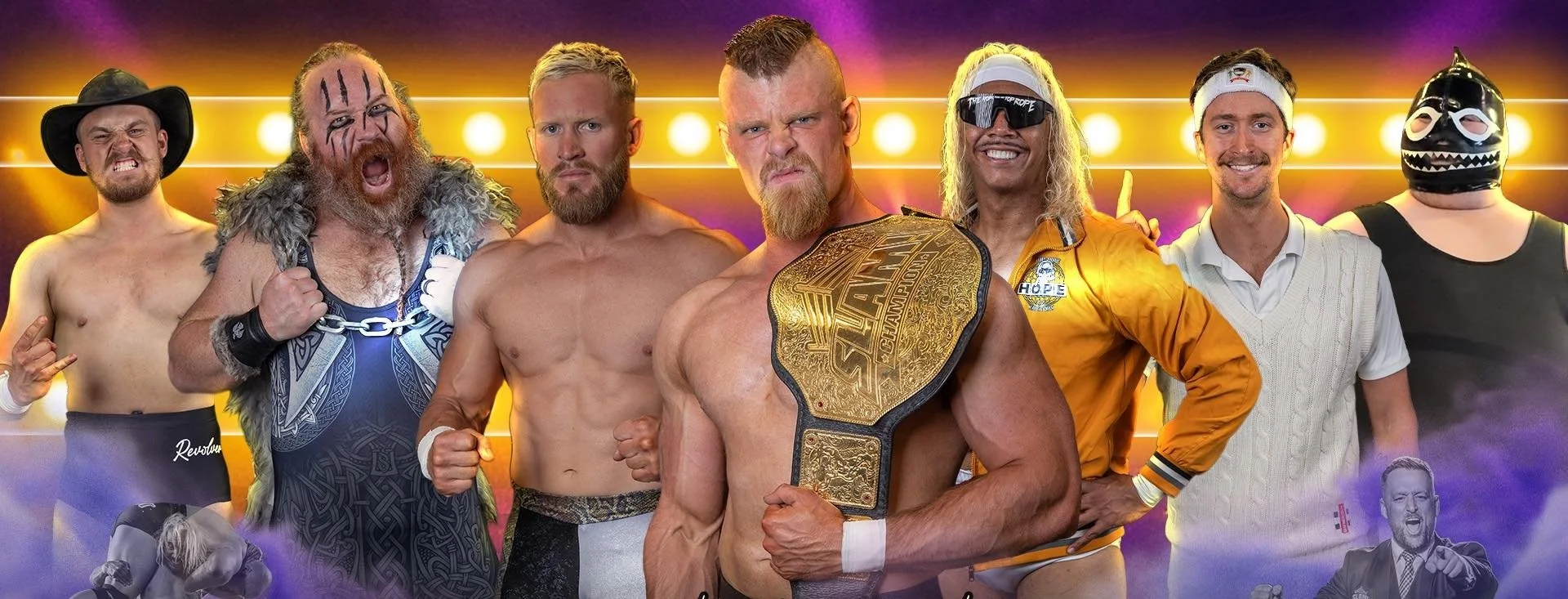
SLAM Pro Wrestling League used to feel like an anomaly. From seemingly out of nowhere, the scene in Canberra (a city of less than 500k people) began going from strength to strength. SLAM Pro Wrestling League launched in late 2021 and had sold-out 500+ seat shows from its very inception, showing a level of pent-up demand that hadn’t been tapped in this part of Australia.
SLAM focuses on pushing local, green talent and using more experienced Australian fly-ins to mentor and elevate them. Audiences were coming back and word was spreading.
That momentum translated into numbers rarely seen for Australian shows. It TWICE set the record for the most attended non-import Australian show of the modern era – drawing 1,713 and 2,432 fans to single shows in 2023 and 2024 respectively. The SLAM audiences were repeat audiences responding to a product that felt distinct, confident, and purpose-built for its market. For a wrestling landscape starved of genuine growth stories, SLAM felt important. You can see this in my reviews of these early SLAM shows.
The SLAM formula
SLAM is unabashedly influenced by New Generation-era WWF in its characterisation and family friendly presentation. The emphasis is on high production values and a slick live experience. Visually, the product is designed to resemble what a non-wrestling fan imagines wrestling looks like: bright colours, broad characters, and a cartoonish aesthetic, complete with a deliberately cheesy American-accent Bruce Buffer sound-alike on ring announcements and video packages. International talent is deliberately excluded.
At the centre of the promotion are its shoot owners and, to date, its only world champions — Dan Archer, Luke Watts, and Mikey Broderick. All three are featured prominently and form the foundation of almost every card. Each has held the top title once, all with lengthy reigns.
Archer, the strongest in-ring worker of the three, currently operates as a cowardly heel champion stringing together DQ and interference title defences. Watts is a fiery, sentimental babyface with an unmistakable 1980s throwback gimmick and exceptional local crowd connection. Archer and Watts also run the training school. Broderick, the inaugural champion, entered SLAM with the most name recognition nationally and has shifted between face and heel as required. He’s limited on the mic and unremarkable bell-to-bell, but he looks like a star and brings valuable interstate connections.
The shows are tight (rarely does a match go past 10 minutes), over in 2 hours and finished by 9:30pm. The house style isn’t workrate-savvy, but leans heavily on characterisation and the fundamental basis of good vs evil, which is perfect for their target audience.
They also upload most of their shows completely free on YouTube, if you’re so inclined.
The fall-off
By 2025, the momentum that once surrounded SLAM had visibly slowed. Announcements of sell-out shows became less frequent, even after the promotion shifted into a smaller room. The annual end-of-year super-show, once positioned as a marquee event capable of drawing thousands, was never announced. Production details that had previously been a point of pride began to slip, and the organic groundswell that once accompanied every event on social media noticeably cooled.
Nothing about the core formula had changed. The shows remained family-friendly. The focus on local talent, supported by experienced fly-ins, was still intact. On paper, SLAM was doing everything that had fuelled its earlier success. And yet, something had clearly stagnated.
What had once felt special now felt routine. Novelty had given way to familiarity, and familiarity quickly drifted into indifference. SLAM became predictable and overexposed. The shows aren’t necessarily bad, but fans began asking themselves whether there was any urgency to seek one out.
Why I stopped going to SLAM
I hadn’t missed a single SLAM show since its inaugural event. For years I was a regular, usually sitting ringside or close to it, fully bought into what the promotion was building. That run ended in March 2025. And not because of one bad show or a single booking decision that irritated me. I stopped because a series of small, compounding issues made attending feel less special, less urgent, and ultimately less worthwhile. Each one on its own was survivable, but adding them all together broke my habit.
A room that killed the vibe
The first crack in my relationship with SLAM came when the promotion settled into a new, but markedly inferior, home base: UC Refectory. While it’s more convenient for me to access than SLAM’s previous venues in Ainslie or Woden, this room just gives weird vibes to a wrestling show.
The venue feels more like a university cafeteria than a place designed to host live wrestling. There’s no soul to the room, sound escapes in awkward ways, it’s uncomfortable to sit in, and the overall presentation comes across as janky and amateurish. A far cry from the polish SLAM had built its audience on. The venue admittedly looks great on camera, but this cannot come at the expense of the live experience.
Previous home venues for SLAM had a way of creating a “bubble” the moment you walked through the doors. You were pulled into SLAM’s world and stayed there for the duration of the show. UC Refectory bursts that bubble immediately. The set-up means that you never forget you’re in a dinky university hall, and once that illusion is broken, it’s hard to re-engage. SLAM built much of its early success on the strength of its live experience. In UC Refectory, that advantage disappeared.
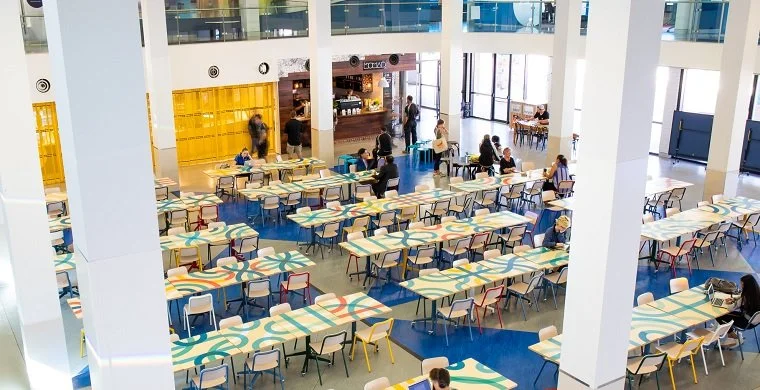
Image: UC Refectory
oversaturation
One of SLAM’s greatest early strengths was its scarcity. Shows were infrequent enough that each one felt like an event. You waited months, watched the card take shape online, hoped tickets wouldn’t sell out before you could grab them, and arrived primed to care.
SLAM has slid into the trap of overexposure that many indies do once they see roaring success. It began running frequent bar shows at Reload. It would put on entertainment at Canberra Raiders games, both outside the venue and as the halftime show. It runs background-noise shows at fitness expos, breweries, university open days, hell you can now even book them for your kid’s birthday party.
SLAM attempted to ride the wave of momentum but ended up diluting the core product. Their events stopped feeling like something you planned around and started feeling like something you might bump into. In 2024 and 2025 it started getting to the point that I would get a calendar notification about a SLAM show and say “Wait, another one already? Ugh”. You can’t yearn for something that doesn’t give you time to miss it. And a feeling of obligation is poison to fandom.

Mitsuharu Misawa is rolling in his grave.
Deeply uncool to its maturing audience
The audience SLAM initially attracted no longer exists in the same way. The first few shows grabbed the attention of the lapsed 2000s WWE fan (the type to chant for Kurt Angle at any submission) and groups of lads out for a night of getting drunk and having cheap laughs at the expense of those around them.
But beyond those transient groups, there was a core fanbase that developed, made up of:
1. young families who wanted a fun night out, and
2. hardcore wrestling fans who wanted to see a local scene succeed.
SLAM really leaned into the former, and saw the success of this strategy in its returning audiences. Both groups are still present in 2025/2026, but in noticeably smaller numbers. Targeting young families is a hard gambit in wrestling. Kids age out of hobbies quickly, and wrestling has always struggled to retain them as interests shift. Without something to grow into, they simply drift away.
This audience is getting older, but the product isn’t growing up with them. SLAM remains locked into a G-rated, New Generation–inspired presentation, even as the audience that embraced it gets older. For kids entering their teens, the show increasingly feels uncool. For adult fans, it feels static. The tone never changes, and neither do the stakes.
SLAM is afraid of alienating the family audience that it found its footing on, so it won’t evolve that tone and presentation. But refusing to evolve carries a cost. Over time, it narrows the audience to a revolving door of the youngest possible fans, with no guarantee they’ll stay long enough to replace the ones drifting away.
Cards need stars, stars need talent
The reason I think the hardcore fans are also losing interest leads me to my last point. It’s admirable to focus on local wrestlers and try to build a scene from the ground up. At its best, that model lets fans watch talent grow from their very first match into something genuinely special, and creates a sense of shared ownership between the promotion and its audience. The feeling that “we were there when it started” was a huge part of what made early SLAM resonate.
The caveat here is that they, y’know, actually have to develop. A lot of the homegrown talent are now closing in on three years of regular reps, and too many of them still feel exactly the same as they did in year one. Or at the very least, aren’t particularly compelling. They’re getting plenty of reps, but they’re reps without progression.
The safe house style is flattening everyone down into a beige wash where both the floor and ceiling of matches is ‘fine’. And there’s no urgency from the talent to step up, because the top spots are locked down by the owners of the company. The matches are competent, the characters are broadly defined, but very few wrestlers feel meaningfully closer to being stars than they were when the promotion launched.
This isn’t me demanding five-star matches or importing bigger names. I just want progression. New wrinkles. Sharper instincts. Risk-taking. The sense that someone is growing and that there actually is a journey for each wrestler that we as fans can invest in, beyond them just showing up for the next show. When that growth stalls, so does audience investment, particularly from the hardcore fans who were willing to be patient because they believed there would eventually be a payoff.
That stagnation is compounded by a main event scene that has barely shifted in three years. The stability provided by the core trio (Luke Watts, Dan Archer, Mikey Broderick) is understandable, but it also creates a ceiling. When the same names anchor every show, the rest of the roster is left circling beneath them, and the promotion begins to feel closed rather than aspirational. You can’t build new stars if there’s nowhere for them to realistically go.
Pushing through the Plateau
There’s still plenty of hope left for SLAM. The promotion identified an unserved market, built an audience from nothing, and proved that Canberra could support wrestling at a level few would have predicted. But the qualities that drove its initial growth (novelty, scarcity, and momentum) are no longer doing the same work they once did. SLAM has plateaued.
And plateaus are broken by evolution: in tone, in stakes, and in who is allowed to feel important. Whether SLAM is willing to make those changes before the audience finishes drifting away is the question that now defines the promotion’s future.
That question also deserves a proper answer. In a follow-up piece, I’m going back and rewatching every SLAM show from 2025 that’s publicly available, starting with the event that marked my exit point. The aim isn’t match-by-match reviews, but to test this theory against the evidence: to see whether the promotion truly stagnated, whether the next generation is beginning to break through, and whether the course correction is already underway.